Role:
Solo builder – Product, Architecture, Full-Stack Development
Tools:
Next.js (App Router), Edge Functions, OpenAI embeddings, Supabase, PostgreSQL, pgvector, Row-Level Security
Summary:
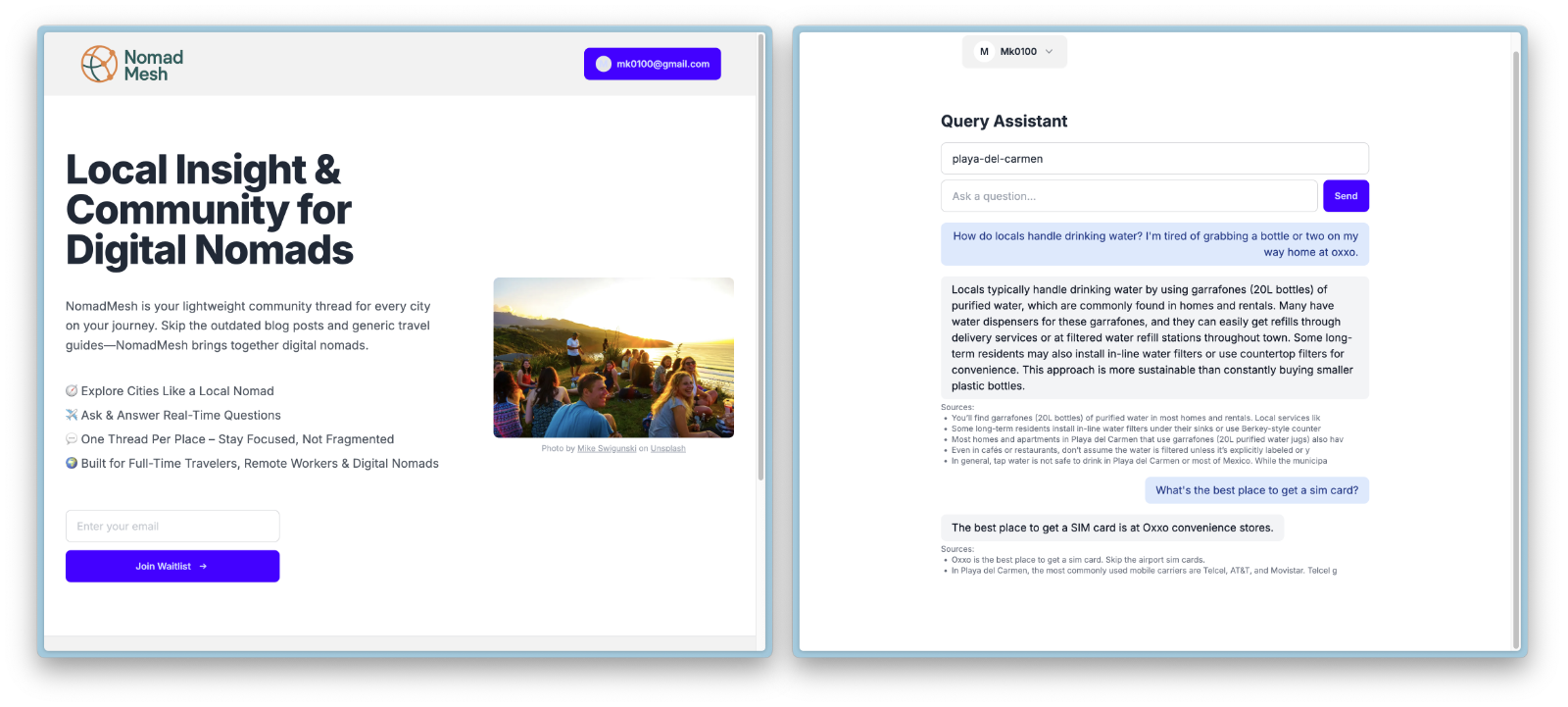
NomadMesh is an AI assistant that answers city-specific questions for digital nomads using real community posts and local guides. Content is chunked into ~200-word slices, tagged by city, and stored in a vector database. Each question runs a similarity search first, and the most relevant entries are passed to the model so answers are grounded in shared experience instead of guesswork.
I scoped it like a product from day one: a pilot persona, a success metric (a relevant answer in under 3 seconds with at least one community citation), a one-day MVP roadmap, and latency and cost tracing around every embedding, search, and completion call.
Technical Highlights:
- Policy-aware retrieval: pgvector searches run through Postgres functions that enforce RLS, so users only pull context for cities they can access.
- Prompt budgeter: right-sizes the context window to stay within latency and cost targets.
- Answer critiques: a lightweight verifier flags responses without citations for review.
- Persisted knowledge: helpful user responses can become AI-augmented entries in the knowledge base.
Why It Matters:
NomadMesh shows how I take an ambiguous AI idea to a working product: clear guardrails, measurable targets, and system design that keeps the model grounded and accountable.
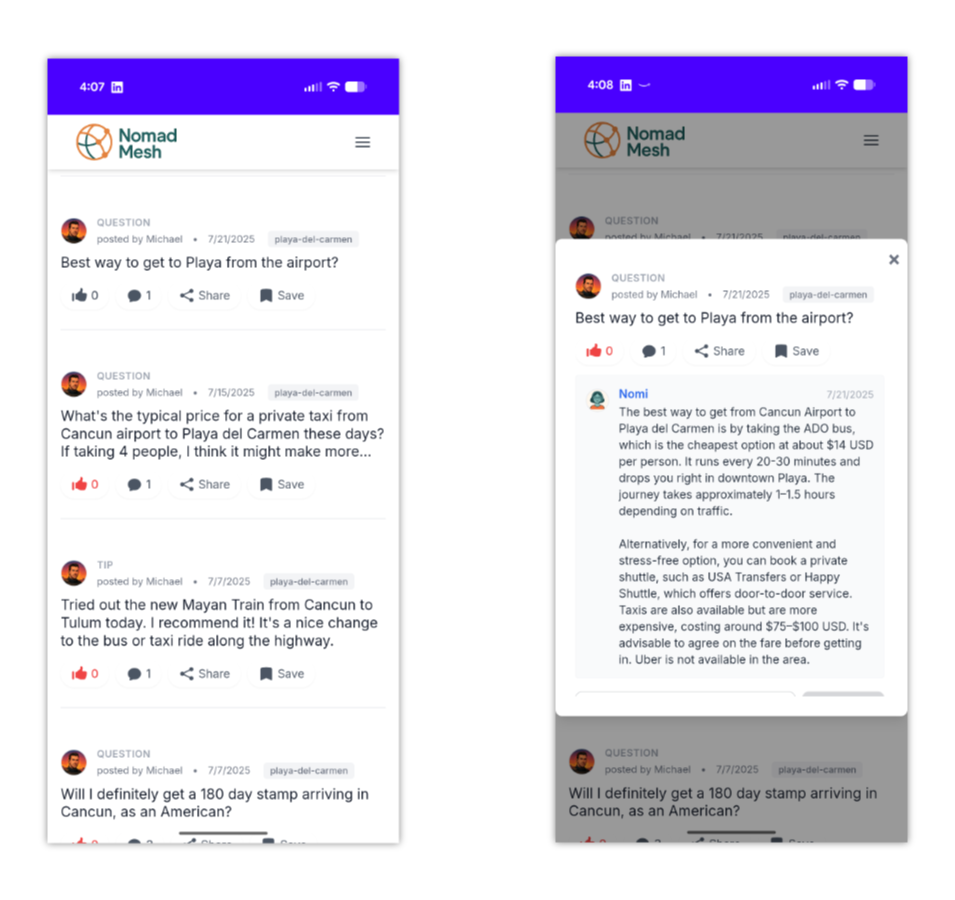
Nomi, the NomadMesh agent, on mobile
Read the full story: From Aimless to AI-Driven